
America Hung a Soviet Spy Bug on Its Own Wall
Inside a carved wooden eagle was a microphone with no battery. It returned a signal only when a transmitter aimed a radio beam at it.
Shorts from this video
A gift for the ambassador
Most accounts date the presentation to August 1945. Soviet Young Pioneers brought the American ambassador, Averell Harriman, a hand-carved Great Seal of the United States as a gesture of friendship between wartime allies. The hard maple carving was about 22 inches across. It went on the wall behind his desk at Spaso House, the ambassador’s residence in Moscow, and stayed there through several changes of ambassador.
The device inside is attributed to Leon Theremin, the inventor of the electronic instrument played without touching it. He had lived in the United States, where RCA built his instruments. After returning to the Soviet Union in 1938, he was charged with spying and sentenced to forced labor. He was sent to a prison laboratory, where he developed eavesdropping devices including the microphone in the eagle.
The memo that gave it away
In 1951, a British radio operator picked up the British air attaché’s voice. An American Signal Corps officer later intercepted a conversation from the US ambassador’s office. Searches turned up nothing, even after technicians passed a metal detector over the seal.
In September 1952, State Department technician Joseph Bezjian moved into Spaso House as a guest of Ambassador George Kennan. Bezjian set up a receiver in the attic while Kennan dictated a fake classified memo to his secretary downstairs. The receiver picked up the ambassador’s voice. Bezjian tracked the signal to the seal and took it off the wall within four minutes of entering the room, according to the NSA history based on his account.
The signal went dead. Bezjian and embassy officer Sam Janey searched the wall for more devices and came up empty. Bezjian slept with the microphone under his pillow. The next morning Kennan carried it to the embassy in his pocket.
The bug that needed a beam
When the FBI examined the device in Washington, it found a small copper cylinder behind the eagle’s beak, closed at one end by metal foil. A small disc sat behind the foil and a thin antenna extended from the cylinder. There was no battery or power cable. The FBI’s 1952 technical report describes a resonant cavity microphone energized by a transmitter outside the room.
Speech reached the foil through pinholes in the wood. As the foil moved, the sound changed the signal returned by the antenna. A receiver outside could recover the voices from that signal. When the transmitter stopped, so did the bug. That helped it escape searches for active transmitters. Accounts disagree on where the beam originated.
The same report notes that the wooden carving reduced the range considerably. The investigators also found an oversized hollow in the carving and suggested it might once have held another device. The report cannot establish what was there before.
What was shown at the United Nations
The United States kept the discovery secret. In May 1960, after the Soviet Union shot down an American U-2 and brought its complaint to the UN Security Council, Ambassador Henry Cabot Lodge opened the seal in front of the Council. The official meeting record records his demonstration. Lodge presented it as the real device, although the episode’s sources note that a CIA file described what he held as a copy.
The date the bug started to operate is also uncertain. The usual account counts seven years from the 1945 gift to the find in 1952. According to the NSA history, State Department security officers later thought the seal went up in 1949 after spending years in storage. The surviving record leaves the interval open.
Archive material
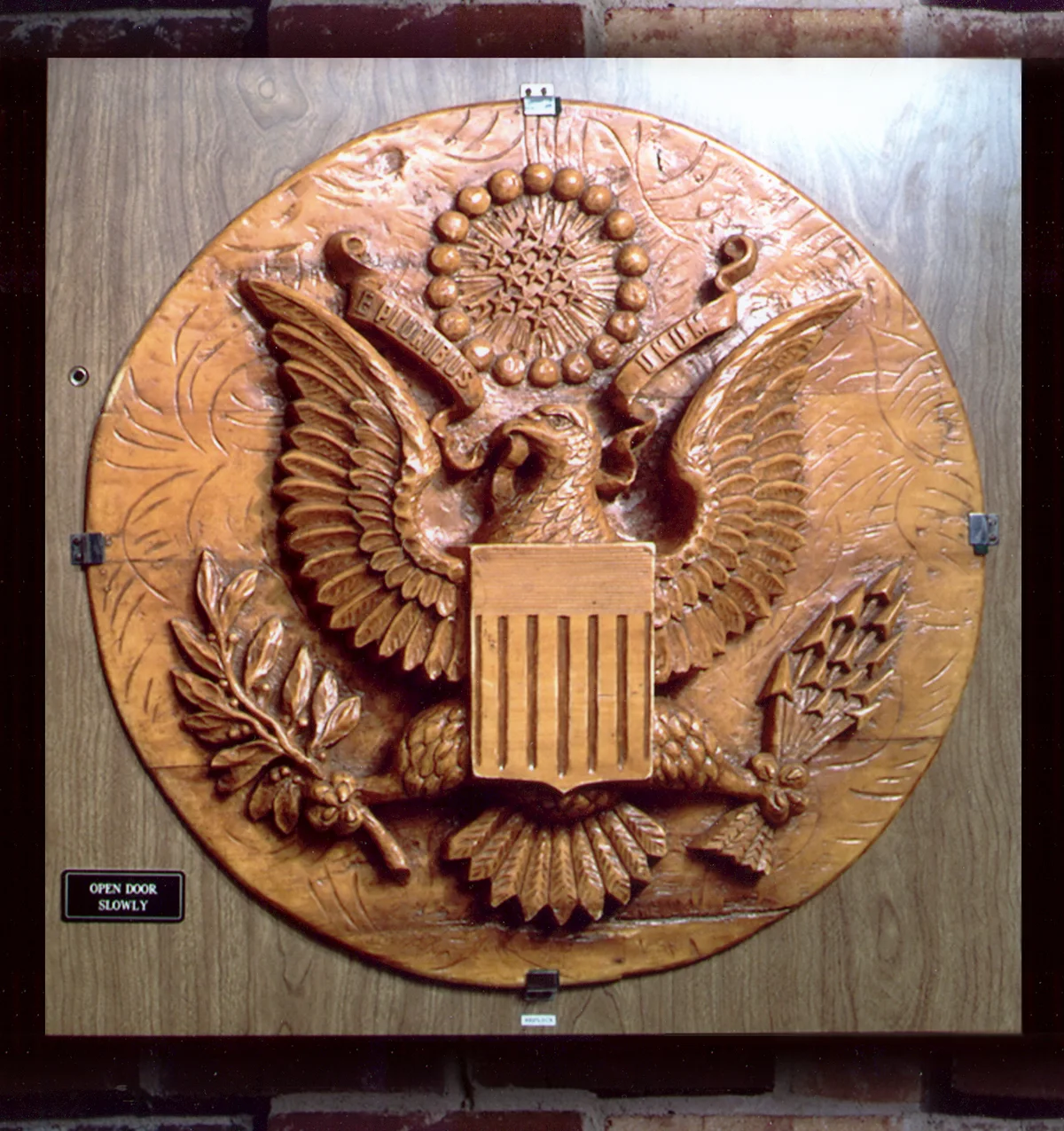
The seal and the listening device.
National Security Agency ·Public domain (PD-USGov)

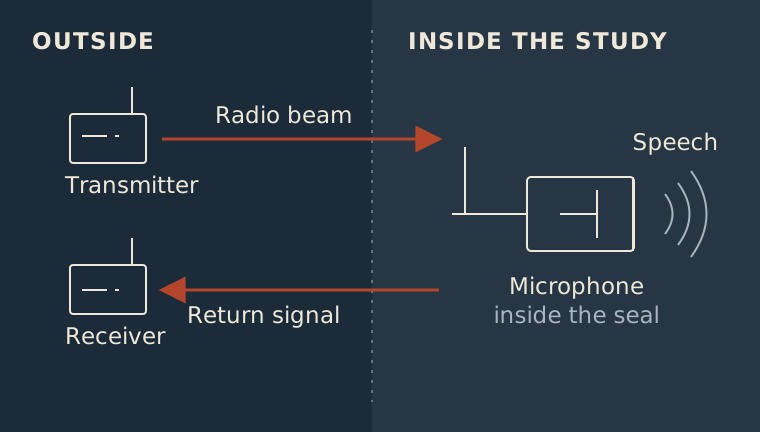
Signal paths are schematic. The transmitter’s location is uncertain.
What we know and how
- Crypto Museum, "The Thing" (Reuvers & Simons, 2015, updated 2022)
- Crypto Museum, "SATYR"
- Final technical report on the Russian resonant cavity microphone Federal Bureau of Investigation · 4 December 1952 (cover letter) · Declassified 24 April 2019Read the report via Crypto Museum
- Mark Nixon, "'The Thing' and I", NSA Center for Cryptologic History, 4 Oct 2018 (based on Bezjian's 1968 narrative report)
- NSA National Cryptologic Museum, "Cold War: Great Seal" exhibit page (3 Aug 2021; same text on the 2008 museum page)
- UN Security Council Official Records, 860th meeting, 26 May 1960 (S/PV.860)
- International Spy Museum, "The Great Seal" (collection highlight)
- CIA, "Compromise of the Great Seal" (26 May 2020), read via WebFetch
- US State Dept Office of the Historian, Chiefs of Mission, Russia
- Office of the Historian, George Frost Kennan
- Bill A. Miller, "DS at 100: A Tradition of Vigilance", Foreign Service Journal, March 2017
- Hugh Griffiths, "The History Column: The Great Seal", IEEE AES Magazine 2022 (author's version, UCL)
- Matt Wilson, "'The most ingenious stunt since the Trojan Horse'", BBC Culture, 26 Aug 2025
- Michael Dervan, "The 'miracle' instrument that led to the gulag", Irish Times, 29 Apr 2011
- Wikipedia, "The Thing (listening device)" (pointer; cited only for uncontroversial facts, labelled)
- Wikipedia, "Leon Theremin" (pointer; labelled)
- Footage Farm listing of the 1960 newsreel "U.N. Spy Debate - Reds 'Bugged' American Embassy Lodge Claims"